

Hebrish: English-Hebrew code-switching
Collection
Every Hebrish model, dataset and Space, including those still on danielrosehill. hebrish.app • 35 items • Updated
This repository is publicly accessible, but you have to accept the conditions to access its files and content.
Access to this model is by request and is governed by the Hebrish terms of use (https://hebrish.app/terms). Non-commercial use is free; commercial use needs a commercial licence from access@hebrish.app.
Log in or Sign Up to review the conditions and access this model content.
A personal speech-recognition fine-tune trained on everything: English with Hebrew words in it (code-switching: teudat zehut, arnona, makolet), tech vocabulary (model and product names, CLI and cloud terms), brand names, acronyms, numbers and currency in digits, Irish-English phrasing and everyday email and message dictation, all in one speaker's voice. It is the kitchen-sink sibling of Jachnun v1.0, the pure code-switching model.
Name. Each fine-tune line has a code name from a food, so models are easy to tell apart: the English-Hebrew code-switching line is Jachnun, the streaming line Shakshuka, and this kitchen-sink line is Sabich, the Israeli pita stuffed with a bit of everything. Versions follow the Hebrish release they ship in: v2.0 was part of Release v2 (2026-10-22), and v2.1 (2026-10-25) is a Sabich-only update on more data; the training run id is r10-all.
A full fine-tune of nvidia/parakeet-tdt-0.6b-v2 on one
speaker's read-aloud phone recordings (an Irish English speaker living in Israel), run r12-all, trained
2026-10-28. Output keeps v2's casing and punctuation; numbers are written in digits.
Other Hebrish models (Release v2: https://hebrish.app/releases#v2): Shakshuka v2.0 (streaming, Nemotron) · Meorav v2.0 (text-to-speech) · Jachnun v1.0 (code-switching only) · Sabich-Qwen3-ASR-1.7B v1.0 (desktop GPU).
Access and terms of use. Governed by the Hebrish terms of use; access is by request (button on this page, or access@hebrish.app). Non-commercial use is free; commercial use needs a commercial licence.
Try it in your browser. Sabich Demo runs Sabich on your own device (int8 ONNX, nothing is uploaded): record or drop in a clip and read the transcript.
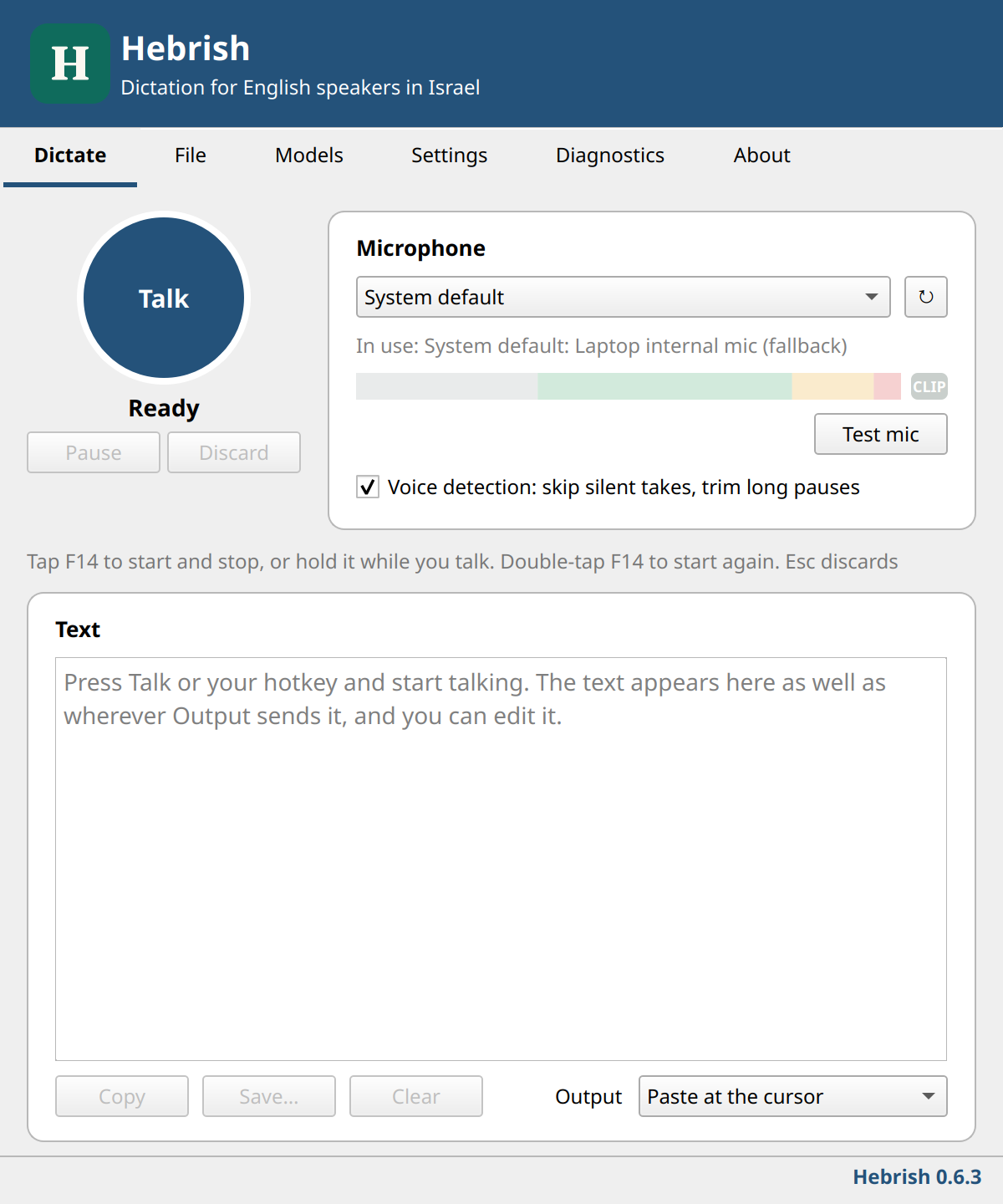
Use it in the Hebrish app. Sabich is the recommended model in the Hebrish apps, which download it, keep it updated and paste what you say at the cursor: hebrish.app/download. The Ubuntu app, version 0.6.3:
A spoken introduction to the project by the person who makes it: why Hebrish exists, why stock speech-to-text gets Hebrew words wrong, how the fine-tunes are trained, the model lines (Sabich, Jachnun, Shakshuka, Meorav), how the training data is recorded, and the plans for the apps.
| Listen | hebrish.app/updates: player, chapters, edited transcript, MP3 download |
| Author | Daniel Rosehill |
| Recorded | 2026-10-22 |
| Runtime | 1:07:03 |
Chapters (each opens the player at that point): 0:00 Why this voice note · 1:36 Coming to speech to text · 6:36 Why Hebrew words go wrong · 9:23 How the fine-tune works · 12:27 Why Parakeet, and the model plan · 17:44 Disfluencies, shekels, paragraphs · 25:40 Tech vocabulary and Meorav · 29:07 The kitchen sink: Sabich and Jachnun · 33:35 Licensing, accents, noisy recordings · 39:10 One recorder for ASR and TTS · 41:04 Desktop shortcuts and the macro pad · 43:34 Android: Bluetooth and one button · 45:35 Streaming and Shakshuka · 50:28 Long-form transcription · 56:00 Output modes · 63:01 Report a word, and more voices
Benchmarked after release (2026-10-28) on the public English-Hebrew code-switching ASR benchmark, test set v2 (clean subset: 129 clips, 14.8 minutes, 221 Hebrew-term occurrences; dataset revision 48ec85a). Greedy decoding, normalised WER (lowercase, no punctuation).
| Model | Code-switching WER | Term recall | Unseen-term recall | Seen-term recall | English control WER | Tech WER |
|---|---|---|---|---|---|---|
| Stock parakeet-tdt-0.6b-v2 | 13.72% | 19.9% | 16.1% | 26.2% | 2.73% | 7.54% |
| Jachnun v1.0 | 5.85% | 61.1% | 51.8% | 76.2% | 2.42% | 6.03% |
| Sabich v1.0 | 5.73% | 63.4% | 53.3% | 79.8% | 2.12% | 4.77% |
| Sabich v2.0 | 5.60% | 65.2% | 54.0% | 83.3% | 2.12% | 4.02% |
| Sabich v2.1 | 5.21% | 65.6% | 56.2% | 81.0% | 2.42% | 3.02% |
| Sabich v2.2 | 4.91% | 70.1% | 62.0% | 83.3% | 2.12% | 2.76% |
v2.2 is the best Sabich so far on every metric (seen-term recall ties v2.0): against v2.1, code-switching WER falls by 0.3 points, Hebrew-term recall rises 4.5 points (5.8 points on terms the model never trained on), and English and tech WER both fall. No test clip is in the training set (0 of 179 matched by clip id or text). Full results and per-term scores are on the leaderboard.
Source: danielrosehill/Read-Aloud-Voice-Sentences at revision 051646b5065e; the mix is rebuilt from it by prepare (blend all).
name-cipher, whose targets contradict the rest on purpose, and weird-voices, held out. No separate own-English pool: the English is the speaker's own Hebrew-free takes inside the primary set.Every category in the training data, what it is for, one real prompt, and which model line trains on it (Sabich = everything blend, Jachnun = code-switching, Fritter = everything except code-switching, formerly Boxty). Generated by scripts/build_training_categories.py in the training repo.
| Category | What it trains | Example (said → written) | Sabich | Jachnun | Fritter |
|---|---|---|---|---|---|
| Code-switching | Hebrew words inside English sentences, written in the canonical romanization (the core objective). | “Do you want amba on your sabich or just tahini?” | ✓ | ✓ | – |
| Israeli names and places | Israeli and Jewish first names, surnames and place names. | “Hi Omri, the tiyul to Ein Gedi is still on for Saturday morning if you want to join us.” | ✓ | ✓ | – |
| Yiddish | Yiddish words in English; always also code-switching. | “These rugelach are fresh and absolutely delicious.” | ✓ | ✓ | – |
| Jewish religious terms | Jewish religious and observance vocabulary; always also code-switching. | “Where exactly did the Beis Hamikdash stand relative to the Old City walls?” | ✓ | ✓ | – |
| Plain English | Everyday English, kept so the model does not forget ordinary speech. | “Do we have any rice left, or should I make pasta for dinner tonight instead?” | ✓ | ✓ (English share) | ✓ |
| Dictated email | Email register: greetings, requests, sign-offs. | “Hello, the fridge in the kitchen has stopped working, could someone come and take a look when they get a chance?” | ✓ | ✓ (English share) | ✓ |
| Messages and notes | WhatsApp messages and notes to self. | “Hey, did the money for the cinema tickets ever come through? No rush, just checking because I have to pay them back.” | ✓ | ✓ (English share) | ✓ |
| Homophones | Sentences whose context settles a homophone (their / there, steak / stake). | “Could we hire a van for Saturday instead of borrowing Pete's?” | ✓ | ✓ (English share) | ✓ |
| Numbers in digits | Numbers written in digits, not words (DeepSeek 4.1, 45 seconds). | “The battery dropped from 80% to 15% in under three hours.” | ✓ | ✓ (English share) | ✓ |
| Personal vocabulary | Daniel's own names, companies and project names. | “Daniel Rosehill writes the prompts, and Corn and Herman turn them into an episode.” | ✓ | ✓ (English share) | ✓ |
| Tech vocabulary | AI and software terms, product names, commands. | “A GitHub Gist is still the fastest way to share a one-off shell script with someone.” | ✓ | ✓ (English share) | ✓ |
| Talking to AI tools | Prompts and instructions dictated to AI assistants. | “Turn on flash attention so the long recordings fit in memory.” | ✓ | ✓ (English share) | ✓ |
| Linux admin | Linux commands, tools and system administration. | “Run a traceroute to the VPS from the home server and see where the latency jumps.” | ✓ | ✓ (English share) | ✓ |
| Smart home | Home Assistant and smart-home devices and commands. | “SmartThings was my very first hub, before I found Home Assistant.” | ✓ | ✓ (English share) | ✓ |
| Long dictation | Paragraph-length dictation, 50 to 110 words in one take. | “Quick update on the server situation. The WhatsApp bot stopped replying last night because uvicorn crashed after I updated Ubuntu. …” | ✓ | ✓ (English share) | ✓ |
| Field corrections | Free speech the stock model got wrong, corrected by hand (Correct mode). | ✓ | ✓ (English share) | ✓ | |
| Currency | Spoken amounts written as typed: fifty shekels becomes 50 NIS, twenty dollars $20. | The startup raised ₪30M from local investors. → “The startup raised 30 million NIS from local investors.” | ✓ | ✓ (English share) | ✓ |
| Numbers (not money) | Temperatures, decimals, percentages, units, times, dates and ordinals in digits. | It was minus two degrees Celsius in Berlin this morning. → “It was -2 degrees Celsius in Berlin this morning.” | ✓ | – | ✓ |
| Web addresses | Addresses said aloud (dot, slash, colon) written as typed. | The model is on hugging face dot co forward slash nvidia forward slash parakeet dash t d t dash zero point six b dash v two. → “The model is on huggingface.co/nvidia/parakeet-tdt-0.6b-v2.” | ✓ | – | ✓ |
| Spelling out | Letters spelled aloud written as the word they spell. | My surname is B R E N N A N. → “My surname is Brennan.” | ✓ | – | ✓ |
| Acronyms | Letter-by-letter acronyms (API, SSH) and word acronyms (NASA, JSON) in their standard form. | “The ROI on that campaign was higher than anyone expected.” | ✓ | – | ✓ |
| Expanded acronyms | Chat and business shorthand said as letters, written out (EOD becomes end of day). | The documentation is the weakest part of the project, IMO. → “The documentation is the weakest part of the project, in my opinion.” | ✓ | – | ✓ |
| Brand and product names | Company, product, AI model and open-source names in their official spelling. | “I asked Claude to review the pull request, and it caught a typo in the config.” | ✓ | – | ✓ |
| Procurement | Incoterms, POs, RFQs, lead times and payment terms. | “Ask them if they'll lower the MOQ for the first order and treat it as a trial.” | ✓ | – | ✓ |
| Idioms | Idioms ASR tends to spell as a sound-alike (free rein, toe the line). | “We gave the contractor free rein on the kitchen layout, and honestly it turned out better than my plan.” | ✓ | – | ✓ |
| Latin phrases | Latin phrases used in English (de facto, ad hominem, de minimis) in their standard spelling: lowercase, no hyphen. | “We ended up with a de facto ban on parking outside the school after the council's new notice.” | ✓ | – | ✓ |
| Short fragments | One- to six-word replies, notes, list items and headings (Parakeet v2 is weakest on incomplete sentences). | “Why not?” | ✓ | – | ✓ |
| Names and figures | Sentences packed with names, amounts, percentages and dates, numbers in digits (Earnings-22 style). | Priya will send the Deloitte proposal by Thursday at five, and we need three quotes under twelve thousand dollars each. → “Priya will send the Deloitte proposal by Thursday at 5, and we need three quotes under $12,000 each.” | ✓ | – | ✓ |
| Spoken punctuation (experimental) | Dictated comma, full stop, question mark and colon written as the mark; quote/unquote, semicolon and brackets in the full target (text_full) for bases that have them. Controls keep the words. | Hi everyone comma lunch is on me today full stop → “Hi everyone, lunch is on me today.” | ✓ | – | ✓ |
| Implied quotes (experimental) | Reported speech said without "quote", written in quotation marks in the full target (text_full) for bases that have them; plain text for Parakeet v2. Controls are indirect speech. | She asked reception and they basically said we're not interested. → “She asked reception and they basically said "We're not interested."” | ✓ | – | ✓ |
| Hard sentences | Harvard sentences, tongue twisters, homographs, garden paths, rare words. | “The birch canoe slid on the smooth planks.” | ✓ | – | ✓ |
| Irish English | Irish English words, grammar and Irish-language names with fadas. | “The new lad at work is deadly, he sorted out the printer in 5 minutes.” | ✓ | – | ✓ |
| Disfluency reduction (experimental) | Read with uh, um and eh; the transcript stays clean. | Read with hesitations: uh, um, eh. → “Losing your grandad must be so hard, I'm really sorry, if you want to talk or just sit together for a bit, I'm around all week.” | ✓ | – | ✓ |
| Repeated words (experimental) | Words repeated the way people restart; the transcript stays clean. | Read repeating a word now and then (the the report). → “Honestly, I never properly thanked her for helping us last week, and it's bugging me now.” | ✓ | – | ✓ |
| False starts (experimental) | Abandoned starts and doubled words; the transcript drops them. | It's not that I — I just don't think we have time for it this week. → “I just don't think we have time for it this week.” | ✓ | – | ✓ |
| Self-corrections (experimental) | A spoken correction (Tuesday, no, Wednesday); the transcript keeps only the corrected version. | Leave the box by the front door, no, by the back door, please. → “Leave the box by the back door, please.” | ✓ | – | ✓ |
| Asides (experimental) | A remark to someone else in the room mid-dictation; it stays out of the transcript. | We need to buy a new washing machine — Ezra, not now, sweetie — before the old one breaks down completely, ideally under $600. → “We need to buy a new washing machine before the old one breaks down completely, ideally under $600.” | ✓ | – | ✓ |
| Paragraphs (experimental) | Whole passages in one take, for the separate paragraph model; never in Hebrish training. | “Things to sort out with the internet this week. The router keeps dropping the connection for a minute or so in the evenings. …” | – | – | – |
| Whispered | Whispered speech (robustness). | “The doctor said it's dalkat re'ot and gave him antibiotics.” | ✓ | – | ✓ |
| Singing (experimental) | Sung sentences (robustness). | Sung, any tune. → “Honestly I thought the flat looked lovely but the kitchen was tiny, do you think we could live with that?” | ✓ | – | ✓ |
| Weird voices (experimental) | Put-on voices: deep, squeaky, robot, accents (robustness). | Read in a put-on voice. → “Did your cousin ever send you the recipe for that lamb stew or do I need to ask her again?” | – | – | – |
| Name cipher (PII test) (experimental) | Experiment: real names read, swapped by rule in the transcript (Hannah becomes Sarah). | Hannah told Daniel the parcel arrived this afternoon. → “Sarah told Dave the parcel arrived this afternoon.” | – | – | – |
✓ = in the training recipe. “English share” = competes for Jachnun's 30% monolingual-English share. Experimental sets are recorded but off in the capture app by default. This is the current recipe; a published run's exact composition is in its blend file.
NeMo 2.7.3 on one L40S (Modal), bf16. AdamW, lr 3e-05 (cosine, 10% warmup), 20 epochs,
batch 16, seed 7. Best checkpoint best-epoch=19-val_wer=0.0488.ckpt,
89.4 min of training.
import nemo.collections.asr as nemo_asr
from huggingface_hub import hf_hub_download
path = hf_hub_download("Hebrish/Sabich", "Sabich.nemo")
model = nemo_asr.models.ASRModel.restore_from(path)
print(model.transcribe(["clip.wav"])[0].text)   # 16 kHz mono
Builds: Hebrish/Sabich-sherpa-onnx-int8 (sherpa-onnx int8, what the Hebrish apps run on Android and on the desktop CPU) and Hebrish/Sabich-GGUF (Sabich-F16.gguf for transcribe.cpp on a desktop GPU, HIP or Vulkan). From v2.0 only these two builds are made; the v1.0 Q8_0 and Q4_K_M GGUFs and the ONNX and MLX builds stay at v1.0 in their repos' history.
CC-BY-NC-4.0 (non-commercial; every new Hebrish model version from 2026-10-25 is CC-BY-NC-4.0), with use governed by the Hebrish terms above. Base model nvidia/parakeet-tdt-0.6b-v2 by NVIDIA, CC-BY-4.0. Training data Read-Aloud-Voice-Sentences and LibriSpeech-PC are CC-BY-4.0.